

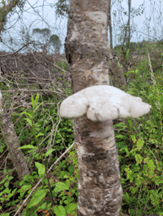
Fomitopsis betulina (syn. Piptoporus betulinus) — birch polypore (razor-strop fungus).
Originally described as Boletus betulinus in the late 18th century, it went through several botanical placements (e.g., Polyporus betulinus) before falling under the genus Piptoporus for most of the 20th century. However, recent molecular phylogenetic studies (DNA-based cladistics) showed that Piptoporus as traditionally defined was not a distinct evolutionary group — Piptoporus betulinus is more closely related to certain Fomitopsis species.
Based on these findings, mycologists reclassified Piptoporus to Fomitopsis and its botanical nomenclature to Fomitopsis betulina to more accurately reflect its evolutionary relationships.
Fomitopsis betulina is virtually exclusive to birch (Betula spp.) and is documented on species such as Betula pendula, B. pubescens, B. papyrifera, and B. obscura.
Birch polypore is found on dead birch and on stressed/dying standing birch. Developing on the main stem and principal branches. It is associated with wounds or dieback which can cause development of the fungus that is latently present in the tree and can colonise living birch and contribute to its decline (parasitic phase). Then it continues to decompose the cellulose in the wood after the host dies (saprotrophic phase).
Lorem ipsum dolor sit amet, consectetur adipiscing elit. Ut elit tellus, luctus nec ullamcorper mattis, pulvinar dapibus leo.
As a weak parasitic saprophyte, no mutualistic symbiotic associations between tree and fungus have been documented.
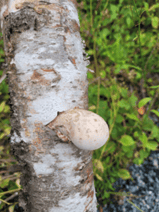
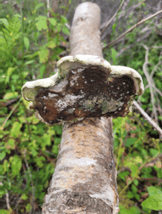
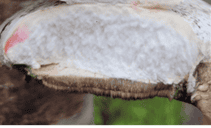
The bracket Initially a “hoof” shaped fructification 50 to 300 millimetres across shiny greyish white with the flesh being thick, white and corky however Fomitopsis betulina often maturing into a brown smooth surface that later cracks with white poor bearing tubes underneath as opposed to gills (these tubes turn brown when overmature, see image 4 & 5). this is usually found growing several feet above ground level occurring individually but within close proximity to other fruiting bodies.
Fomitopsis betulina is a very versatile fungus and its other uses include medicinal applications as an antiseptic wound dressing — strips placed directly on cuts and reduce infection risk; Styptic (bleeding control), thin slices were used to press onto small wounds to promote clotting. Sometimes brewed into a bitter tea as a remedy for digestive complaints and parasites.