

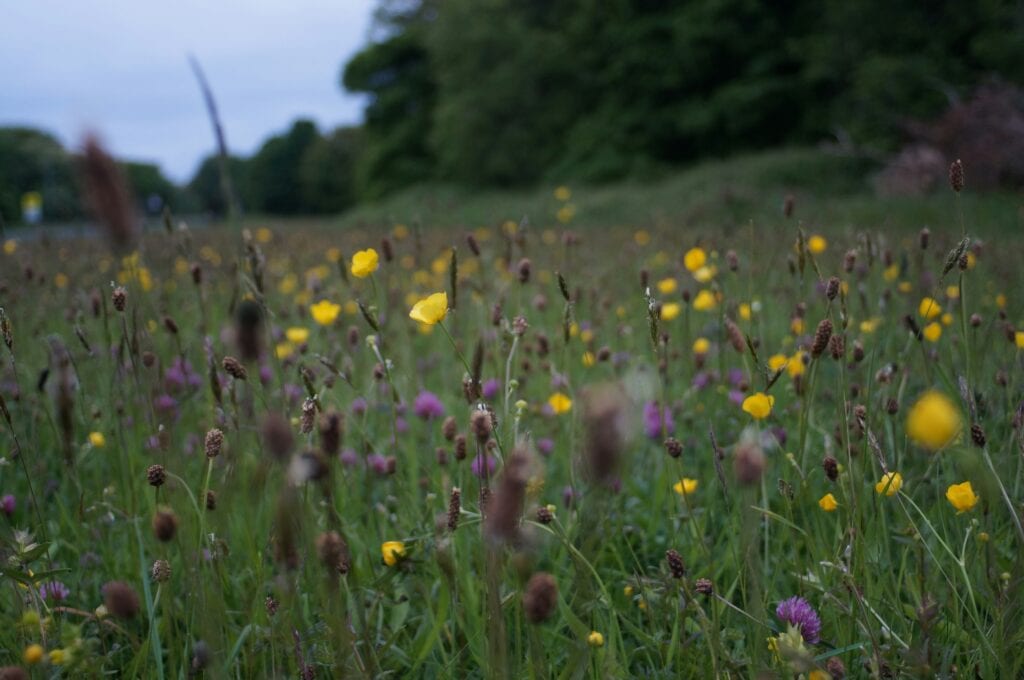
Corporate biodiversity projects are becoming increasingly visible across Ireland. Wildflower areas appear at business parks, reduced-mowing signs stand beside roads and office campuses, and beehives have become a familiar feature of sustainability programmes.
These initiatives may be well-intentioned, but visible activity doesn’t necessarily equal ecological improvement. The more useful question is not whether a site looks greener. It is whether biodiversity is actually benefiting. That question should begin with a baseline.
Start by measuring what is already there
Before deciding what biodiversity action to take, an organisation should understand the habitats and species already present on its site.
An existing native hedgerow, meadow, wet grassland, mature tree line or patch of scrub may have considerably greater ecological value than a newly created feature. Removing established habitat to install something more visually attractive can achieve the opposite of what was intended.
A baseline ecological assessment provides a reference point against which future change can be measured. What habitats are present? What condition are they in? Which species are using the site? Are invasive species present? Where are the opportunities for improvement?
Without that starting point, an organisation may be able to report what it has done, but it is much harder to demonstrate what has actually improved.
The All-Ireland Pollinator Plan 2026–2030 places increased emphasis on monitoring, with 50 strategic aims and 75 success metrics across its work programmes. For businesses, it also recommends mapping, tracking, and measuring actions so progress can be assessed over time.
Think twice before reaching for the seed mix
The All-Ireland Pollinator Plan is clear that sowing commercial wildflower seed mixes is not recommended as a biodiversity action. Instead, it generally prefers changing the management of existing grassland and allowing local wildflowers to emerge naturally from the existing seed bank. Reduced mowing, together with removing the cuttings, gradually lowers soil fertility and gives naturally occurring wildflowers a better opportunity to compete with vigorous grasses.
Commercial seed mixes can contain non-native species, and even mixes labelled as native may contain seed originating outside Ireland. There is also a risk of accidentally introducing unwanted species into the wider landscape.
Where intervention is genuinely necessary, locally sourced native seed or appropriately sourced native planting may help, but consider natural regeneration first. It may take longer and look less impressive at first than a brightly coloured seed mix. Ecologically, however, patience can produce a more appropriate result.
Mow less, but manage properly
Reduced mowing is one of the simplest ways to improve grassland for pollinators, but the goal isn’t to abandon mowing. Management depends on the type of grassland you’re creating.
For a short-flowering meadow, the Pollinator Plan recommends letting early flowers, such as dandelions, bloom and then cutting about every four to six weeks. A long-flowering meadow is generally cut once, usually in September after plants have set seed. The key point in either approach is removing the cut material.
Leaving cuttings behind returns nutrients to the soil and favours vigorous grasses. Removing them gradually reduces fertility and creates better conditions for a wider range of wildflowers to develop. Therefore, choose an appropriate regime for the site rather than applying the same mowing schedule everywhere.
Beehives and biodiversity are not the same thing
Honeybee hives are another highly visible corporate initiative. Honeybees are valuable managed pollinators, but installing an apiary is not considered a biodiversity action under the All-Ireland Pollinator Plan. Increasing honeybee numbers can also increase competition with wild bees for floral resources.
This does not mean organisations should not keep honeybees. It simply means that beekeeping and wild-pollinator conservation should not be confused. If the objective is biodiversity enhancement, management should also consider Ireland’s wild bumblebees, solitary bees, hoverflies, moths and the feeding, nesting and overwintering habitats they require.
Pesticide-free should be the objective
A site cannot easily claim to be managed for pollinators while unnecessary pesticide use continues. Current Pollinator Plan business guidance recommends eliminating pesticide use, retaining targeted herbicide treatment where necessary to control invasive species such as Japanese knotweed. Where immediate elimination isn’t possible, reduction should be seen as a step toward that objective.
That means reviewing routine spraying around kerbs, paths, fences and landscaped areas rather than accepting chemical treatment as standard maintenance practice.
Invasive species management is different. Carefully targeted treatment may be required as part of an appropriate eradication or control programme.
Measure what happens next
Perhaps the biggest weakness in some biodiversity programmes is measuring success by actions completed rather than ecological outcomes achieved. A business may report that it reduced mowing across five hectares, planted native trees, or altered its grounds-maintenance contract.
But has biodiversity improved? That requires comparison with the original baseline. Monitoring does not have to be unnecessarily complicated. Depending on the site, it might examine changes in plant diversity, pollinator activity, habitat condition, invasive species, or how particular species use habitats.
The important point is that the measures should be repeatable. A business investing in biodiversity should eventually be able to answer four straightforward questions: What was here before? What did we change? What happened as a result? Can we demonstrate the difference?
From visible action to measurable improvement
Wildflower areas, reduced mowing, native planting and other interventions can all contribute to biodiversity. But choose them because they suit the site, not because they make for an attractive photograph in a sustainability report.
For Irish businesses and public bodies managing land, the better approach is to establish a baseline, protect the valuable habitats already present, identify realistic opportunities for improvement, adopt appropriate long-term management and then monitor what happens. Sometimes that will involve planting. Sometimes it will mean cutting grass less frequently and removing the cuttings. Sometimes it will mean stopping routine pesticide use.
Sometimes the best biodiversity action is simply to protect and manage what is already there. The real test is not what the site looks like on launch day. It is whether, several years later, the evidence shows that biodiversity has actually improved.