

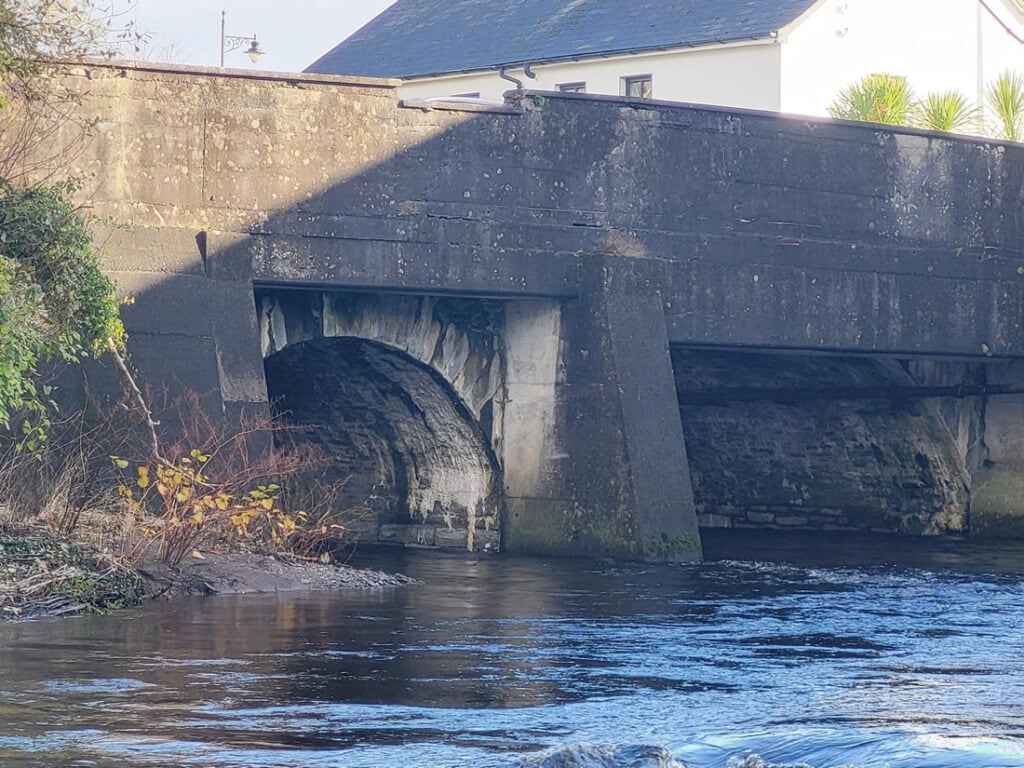
Veon Ecology was commissioned to conduct a bat survey on a bridge in Co. Meath. This involved investigating crevices and joints for roosting bats and to assess their suitability as bat roosts. This work is normally undertaken during the daytime. Bat surveys are instigated when there is a risk that the bat’s natural habitat may be interfered with, disturbed or disrupted. Bats are a recognised protected species, meaning that, by law, it is an offence to disrupt their environment.
In the absence of traditional roosting sites such as old mature trees, bats have adapted to man-made structures such as bridges. The grout and mortar in old masonry bridges may be slowly eroded by water thus creating crevices and gaps where stones become dislodged. These crevices and gaps develop to form valuable roosting sites for bats. The impact of heavy traffic on bridges may also cause fissures to develop and provide opportunities for bats to roost especially where the bridge traverses a waterway which is largely free from human disturbance and enjoys relatively constant temperature and humidity.
Bats are a protected species in Ireland due to their ecological importance, as they play a crucial role in maintaining a balanced ecosystem by controlling insect populations through predation.
Bats are classified under the Order Chiroptera, with all eight bat species in Ireland being insectivorous and falling under the suborder Microchiroptera. The Lesser Horseshoe is part of the Family Rhinolophidae, while the remaining seven species are members of the Family Vespertilionidae. Irish law protects all bat species under the Wildlife Act 1976, as amended in 2000, and the Habitats Directive, transposed through the European Communities (Natural Habitats) Regulations (S.I 94 of 1997), as amended. Furthermore, the Irish government is a signatory to the Bonn Convention (Convention on the Conservation of Migratory Species of Wild Animals, Bonn 1979) and the Bern Convention, 1982 (The Convention on the Conservation of European Wildlife and Natural Habitats), and is committed to the “Eurobats” agreement (Agreement on the Conservation of Bats in Europe, 1991) (NRA 2005).
In Ireland, two of the eight bat species are identified as threatened in the Irish Red Data Book: the Whiskered bat (Myotis mystacinus) and Natterer’s bat (Myotis nattereri). The remaining six species, including the Lesser Horseshoe (Rhinolophus hipposideros), Daubenton’s (Myotis daubentoni), Leisler’s (Nyctalus leisleri), Long-eared (Plecotus auritus), and the two Pipistrelle species (Pipistrellus pipistrelles and Pipistrellus pygmaeus), are internationally recognized as important. This classification applies to species that, while common and widespread in Ireland, are considered rare or threatened in the European Community.
Bats face various threats, including habitat loss, disturbance, and changes in land use. Legal requirements for bat surveys are designed to assess the presence of bats in specific areas, especially before any development or construction projects take place. This helps identify bat roosts, feeding areas, and commuting routes, allowing for the development of strategies to mitigate potential impacts on bat populations.
Survey data from Veon’s ecologists can inform decision-making processes, ensuring that development projects are conducted in a way that minimizes harm to bat populations and their habitats. Legal frameworks may also include measures for the protection of bat roosts and their surrounding areas.
#batsurvey #bats #veonecology #veon #bridges #bats #meath #chiroptera #microchiroptera #rhinolophidae #vespertilionidae #wildlifeact1976 #habitatsdirective #bonnconvention #conservation #eurobats #whiskeredbat #myotismystacinus #natterersbat #myotisnattereri #lesserhorseshoe #rhinolophushipposideros #daubentons #myotisdaubentoni #leisler #nyctalusleisleri #longeared #plecotusauritus #pipistrelle #pipistrelluspipistrelles #pipistrelluspygmaeus